

THE IMPERATIVE OF MOVEMENT
WATER LILY
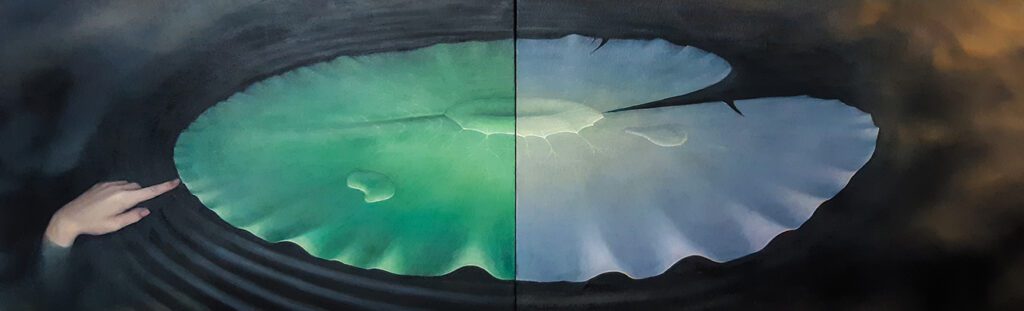
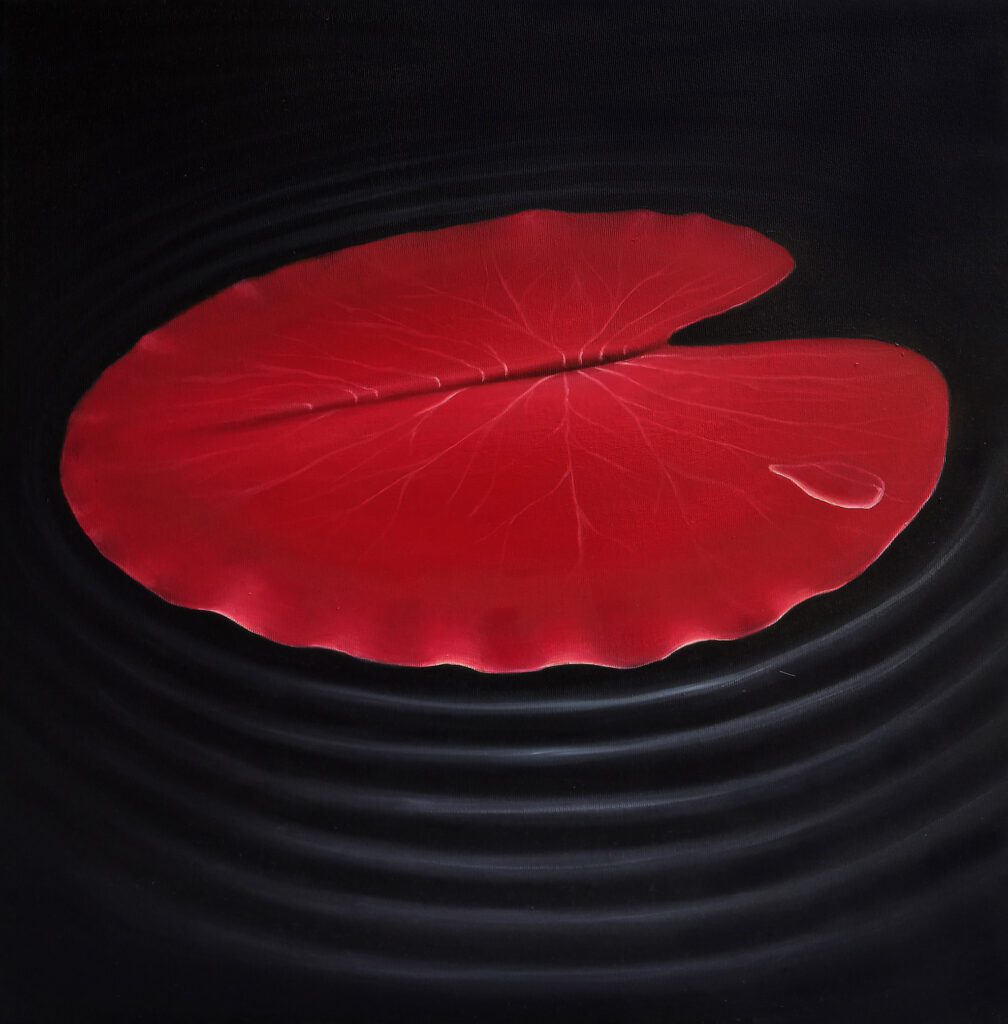
The need to reshape the work and the thought of the crowd that was created in my head during one period, prompted me to think that the previous topics should be extracted into some other forms. From certain examples, I realized that by needlessly filling the scene on the canvas, I am threatened by the fear of empty space. The moment before diving into a new subject followed the refining of the image into slightly different forms of presentation. The realization of what was envisioned happened by decompose the form and simplify the scene. The introduction of water lilies as a special element around which I continued to generate my works, this time mostly paintings, oil on canvas, helped me clarify the complicated scene and the unnecessary fullness.
SPEECH
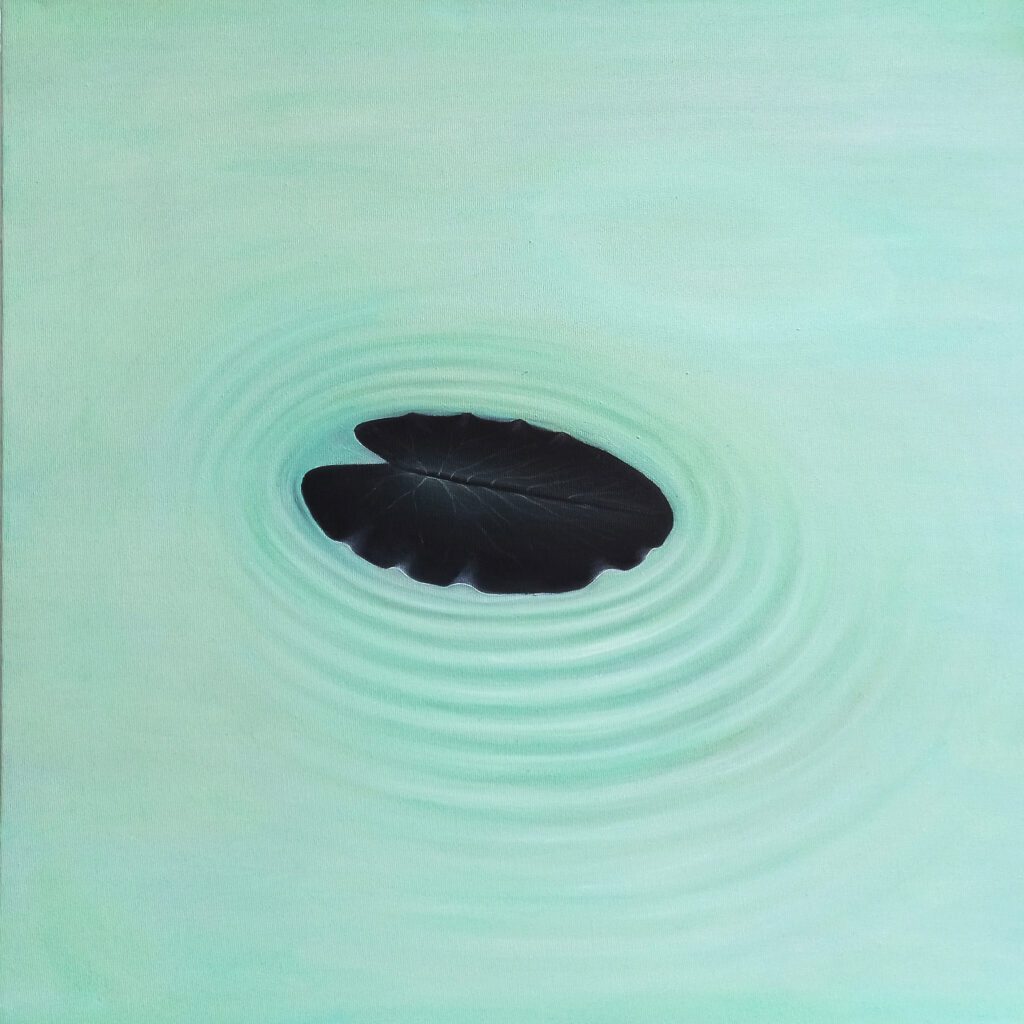
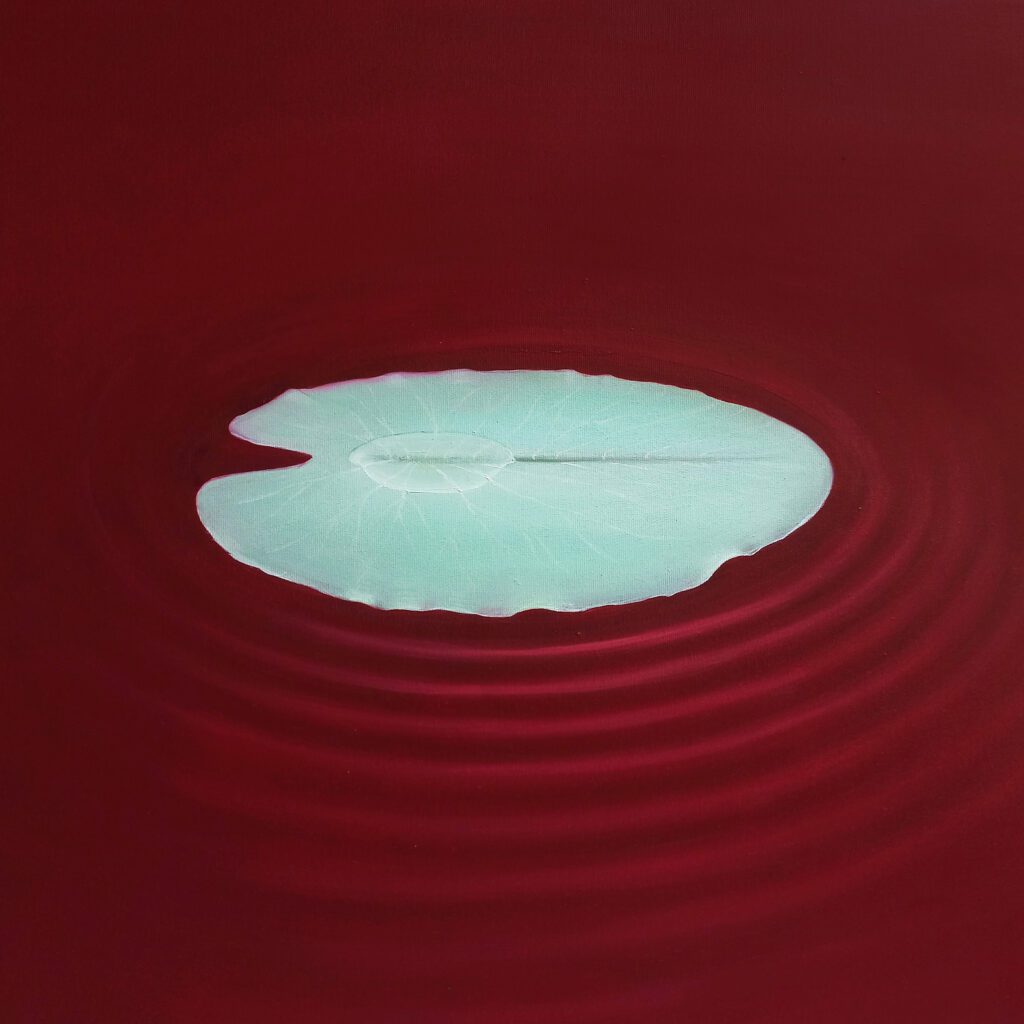
The symbolism of the water lily varies from one culture to another. In the Buddhist tradition, it symbolizes morality, but also rising above material desires. Today in eastern countries the water lily is a symbol of dawn and birth, while in western countries it is a symbol of chastity and purity. And while it grows in the mud and retains its delicacy, both of existence and movement, its strength and endurance are far more fascinating especially when one considers its thin appearance. The subtlety of the existence of this plant is expressed by oscillatory waves that arise on the surface of the liquid in which it lives. There is one catch that visually does not match the shape of the wave movement on the water. Their metrics and layout are more like a spread of sound. Spherical sound waves are created by oscillating a point source or by pulsating a sphere. The source of sound can be any body that performs mechanical oscillations in an elastic medium and thus causes a disturbance of the medium, thereby communicating energy to the particles of that medium. Trying to understand the technical appearance of these displays in physics, I tried to imitate their appearance. In this way, this living object on the water spreads around itself sound signals that often look like movement. That "whisper" is the silent scream of one who is thought to be silent. There is Aristotle's thesis that plants have souls, but not feelings, which was represented throughout the Middle Ages. Later in the 18th century, the botanist Carl von Line came to the conclusion that the only difference between flora and fauna is that animals move, and that in the extremely physically noticeable way we are used to. I say "in a noticeable way" because Charles Darwin already in the 19th century proved its movement on a vine. Plants express their aspirations in the form of movement, but only in cases of necessity and benefit for the individual itself, as well as the rest of the plant world. Already in the next century, the biologist Raoul France intrigued science with his evidence that the elegant way of moving a plant does not really differ from that of a human, but is only much more subtle (and slower), and a person who does not have time to pay attention will not even notice it. The meditative method of building scenes is coherent with the way this plant exists. The simplicity of the situation and the fragile methods of production bring to the surface the subtlety of movement. The significance of such a form of existence is equally important, but also instructive for a homo sapiens today. In a sea of too much everything, each of us is faced with a constant imperative of speed and movement as such.
PROTO - PLANT
Goethe's theory about the archetype of plants is interesting. The idea of the proto-plant, that is, the part of the plant from which each one arose, was connected to the story of micro-evolution. Goethe proposed a philosophical theory about the various manifestations of being as an archetype, which has the ability to take on the most diverse forms that may have been unseen before. That primitive organism was interpreted as a form of the Platonic idea understood through the eyes of an artist. Great - plant is not an individual, but a force that moves the form to life and constant change. Hence her movement. Goethe's philosophy is described by metaphysical observation of nature. Its concept is that the divine force cannot act if something is immobile, therefore not a single living being, not even a plant, is motionless. This force can only exist in living things, because only living things are subject to change. Thus, the theory of final embodiment falls away. This tendency towards development and change is related to latent movement - movement in a state of rest. That's exactly the way I could best describe the shapes in my pictures.
UKIYO-E
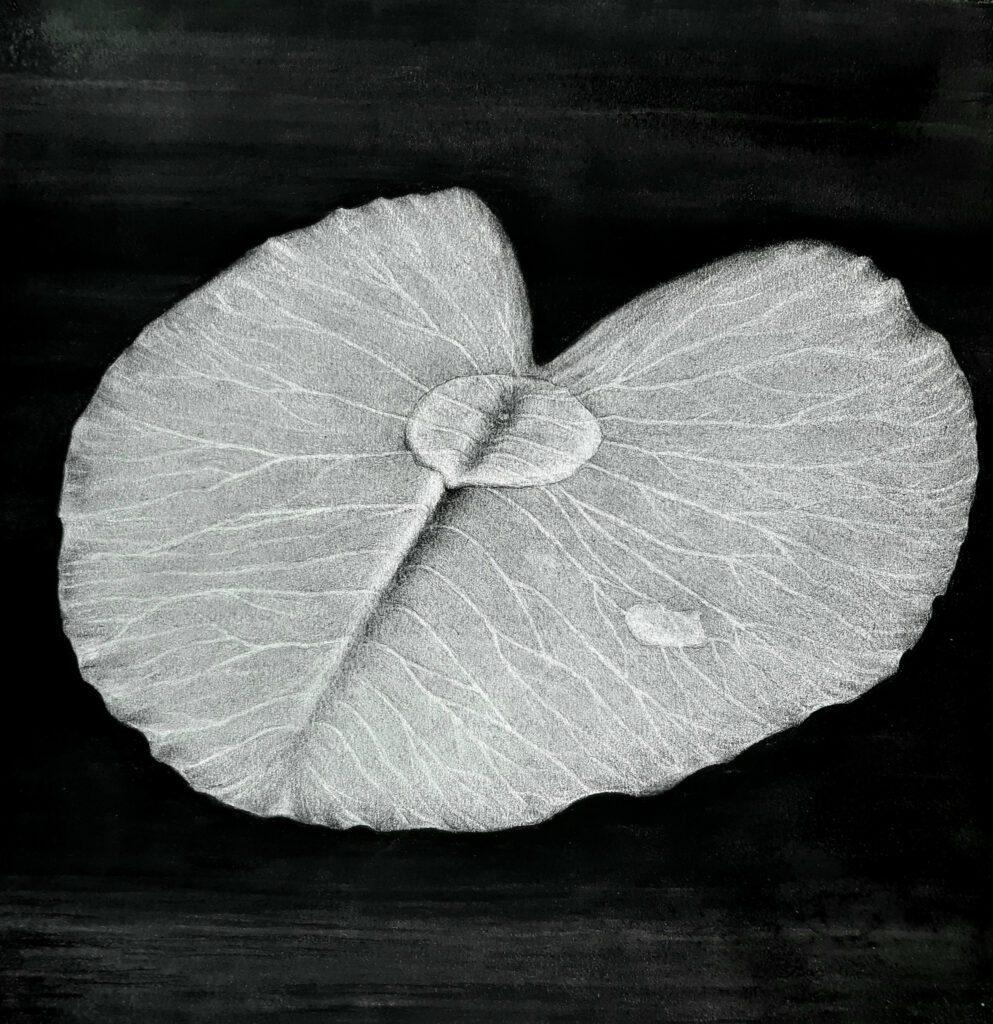
The method of vertical visual representation of the triptych called Nymphaeaceae (Water Lilies), 2022. I would best explain it with Dušan Pajin's text, quoting his passage from the book Philosophy of the Arts of China and Japan: "In an intimate, contemplative mood, unity with nature and natural forces is achieved. Siren believed that this type of painting had its roots in the connection between painting and calligraphy in Chinese art. Namely, since Chinese calligraphy was written in vertical lines from top to bottom, he believes that this logic was simply transferred to painting, that vertical pictures (which were scrolls) were conceived, if not painted, from top to bottom in those days, that is, from the background to the foreground, since the highest point was also the farthest." Ukiyo-e (Japanese: 浮世絵 – literal translation - pictures of the floating world) is a genre of Japanese paintings and woodblock prints. Ukiyo is a word that comes from Buddhism and describes the transience of human life. It also initiates acceptance as well as non-attachment to desires and cravings. This style was characterized by clarity, boldness of composition and clean surfaces without unnecessary details, while instead of classical depth, the space was shown with flat surfaces. Chinese art had the greatest influence on this. The closest parts of the picture would be lowered to the bottom, while objects in the distance would be represented by width and simplicity of form. It is interesting that the depth was achieved completely differently from the classical, European perspective. The space shown in my works is a combination of these two styles. I see the constant duality of East and West as a personal struggle for myself.
MOVEMENT
As stated in the book The Secret Life of Plants (Peter Tompkins, Christopher Bird), plant senses are far superior to our senses and react most reliably and readily to the world and space into which they are brought. They are in a constant state of perception and memory in their cells, so that the anthropocentric man can learn a lot from them, even what he cannot perceive with his five senses. They distinguish the finest frequencies that the human ear cannot feel, as well as various colors in the form of infrared and ultraviolet, which the human cannot see. Like us, they are influenced by the stars and other celestial bodies in space. Even then, France claimed that they contain all the characteristics of living beings, as well as reactions to different human intentions, gratitude for good interaction with them, but also extremely violent reactions to abuse. The opinion considered most of the discoveries as heretical and shocking, especially the claim that the consciousness of plants can come from other worlds from other planets. Similar claims are found in various myths of Native Americans, as well as Hindu and Celtic peoples. Only after the metaphysical and physical inventions beginning in the 60s and 70s of the last century, and up to today, have various points of view been confirmed as correct. All this could be proven using a galvanometer, a part of the polygraph that connects the electrodes to a person, and in these cases to a plant. It clearly shows the reading of human intent if we want to harm it in any way. Similar research reaches to the various reactions of plants to the destruction of the living world around them. Cytologist, Dr. Howard Miller concluded that some form of cellular consciousness apparently connects all living world to the planet. Various discoveries of extrasensory perception were extremely interesting to me as concepts for further research in the work. In the placement of the subjects in relation to the rest of the scene, I try to build a narrative that leads the viewer to feel the future moment - just before it happens. I build that using the minimal movement of the plant, but also its response to the environment. That's how I try to express an intuitive moment to the observer.
I think that each individual is a small meditative body whose voice always exists and can be visible, even heard far away, if its source is strong and steady enough. Appearances and ways do not necessarily have to be explicit to be noticed. I actually think that is the least successful path. The subtlety of the movement clearly shows in force even below the surface of the primarily visible. It is a significant hook thrown in response to today's imperative of movement that has grown into constancy. Hyperproduction and the need for originality leads to the replacement of quality and quantity, which is disastrous for today's society, but also for the one that follows and rests on this now. After various methods of finding the subconscious construct of building work, I realize that it is just a process. When I say "just" I'm not diminishing the meaning, but I mean something too personal that was built around me, but didn't let me know that it should jump out of the frame of itself. The topic has been similar for a couple of years, but the implementation and forms of work, as well as techniques, are changing. Any deeper symbolism remains at the level of what a symbol should be, and which remains in my sphere of interest for research, but not in the core of the creation itself. Landscapes of water lilies are a representation of personal space through a continuous clash between reality and its simulation. What is set as an axiom today, what manage our motivations and whether constant movement in the speed of existence is the only way to be successful, is only part of the question that arises.